

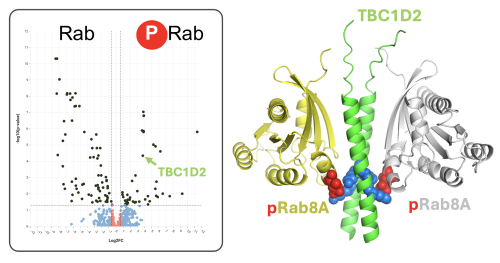
Our new preprint maps the phospho-Rab interactome and identifies proteins that Rab GTPases gain and lose as binding partners when LRRK2 phosphorylates them. We used purified phospho-Rabs as baits to identify these interactions directly. Phosphorylated and non-phosphorylated forms of Rab1, Rab3, Rab8, Rab12, Rab35 and Rab43 were compared in pulldowns from cell lysates and mouse brain, alongside Rab7, a substrate of the related kinase LRRK1. Recovery of the established phospho-Rab effectors RILPL1, RILPL2, JIP3 and JIP4 supports the approach. Two findings stood out:
- Phosphorylation disrupts binding of majority of previously characterised effectors. Many canonical partners bound less well to the phosphorylated Rabs: This includes the TRAPP trafficking complexes lost binding to Rab1A and Rab43, and the presynaptic RIM1/2 proteins recognised Rab3A but not phosphorylated Rab3A. The modification appears to act substantially by breaking existing Rab complexes, as well as enabling the recruitment of a smaller number of new effectors.
- We identify TBC1D2 as a previously unreported phospho-Rab effector. It bound several phosphorylated Rabs, and AlphaFold modelling, mutagenesis, co-immunoprecipitation and isothermal titration calorimetry showed that a conserved di-lysine motif (K410/K414) within its central coiled-coil domain binds phospho-Rab8A and phospho-Rab3A with nanomolar affinity. This establishes the coiled-coil as only the second phospho-Rab(GTP) recognition module to be characterised, after the RH2 domains of the RILP-like and JIP protein families.
TBC1D2 is a GTPase-activating protein for Rab7A that has been implicated in LRRK1-dependent regulation of endolysosomal dynamics, so this interaction may mark a point of convergence between LRRK1 and LRRK2 signalling. In future work it would be important to explore whether phospho-Rab8A binding could redistribute TBC1D2 away from Rab7-positive membranes, or impact the catalytic activity of the GAP domain. To address these questions in future work, we will need direct measurements of TBC1D2 localisation, GAP activity and Rab7A-GTP levels.
The complete datasets are available as an interactive resource: per-Rab volcano plots through CURTAIN (https://curtain.proteo.info), and a search portal through Cinder (https://cinder.proteo.info) a new tool we have created that returns the enrichment of any candidate protein across the full phosphorylated and non-phosphorylated Rab panel in both cells and brain. Both of these tools were created by Toan Phung. Several limitations apply. The bait proteins lacked their C-terminal hypervariable regions and were not membrane-anchored, and because the screen reports differential enrichment, effectors that bind both forms equally will not appear as phospho-selective.
This was a collaborative effort between Amir Khan's group at the School of Biochemistry and Immunology, Trinity College Dublin, and our group at the MRC Protein Phosphorylation and Ubiquitylation Unit in Dundee, with Eve Napier and Matthew Jaconelli contributing equally as first authors. We thank Suzanne Pfeffer for helpful advice, and the MRC-PPU sequencing, tissue culture, mass spectrometry and reagents teams for their support. The work was funded by Research Ireland, the UK Medical Research Council, and Aligning Science Across Parkinson's.
The preprint is available on bioRxiv (https://www.biorxiv.org/content/10.64898/2026.11.22.767923v1). We have also submitted this article to a peer reviewed journal.