

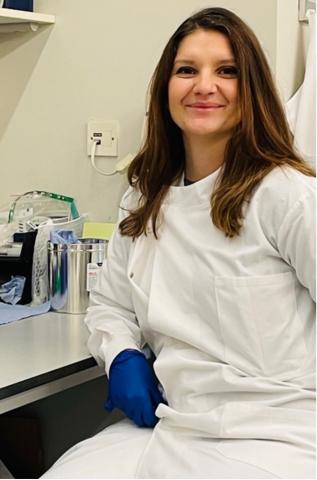
I obtained my undergraduate degree (BSc) in Molecular Biomedicine from the University of Copenhagen (2010-2013), after which I moved to Cambridge, UK to complete an MPhil in Medical Science, under the supervision of Prof Susan Ozanne and Prof Kenneth Siddle at the Metabolic Research Laboratories - Institute of Metabolic Science (Wellcome Trust-MRC). My MPhil research focused on the contribution of microRNAs to the development of insulin resistance as a result of a suboptimal nutritional environment in utero.
I subsequently completed a four-year Wellcome Trust PhD Programme in Metabolic and Cardiovascular Disease (2014-2018), with an initial MRes year. During my PhD with Prof Robert Semple, I engineered the first human induced pluripotent stem cell models with endogenous expression of either one or two copies of the cancer-associated PIK3CA-H1047R variant. Our initial aim was to study the potential mechanisms whereby this mutation causes rare, developmental overgrowth disorders known as PIK3CA-related overgrowth spectrum (PROS). In the course of this work, we discovered allele dose-dependent effects of genetic PI3Ka activation, suggesting that there are quantitative PI3K signalling thresholds that may determine the pathophysiological consequences of PIK3CA mutations in human diseases, most notably cancer.
After a short postdoc in the Semple Lab upon its move to the University of Edinburgh (2018-2019), I joined the laboratory of Prof Bart Vanhaesebroeck at University College London. From 2019-2020, I worked on developing highly robust, cell-based quantitative assays for studies of small molecule-mediated PIK3CA activation. In a separate project, I also used computational approaches to identify evidence for dose-dependent PI3K signalling activation in human breast cancers with one or multiple copies of activating PIK3CA mutations.
In December 2020, I was awarded a Sir Henry Wellcome Postdoctoral Fellowship to study the systems biology of PI3K-dependent phenotypic plasticity, with primary basis at UCL Cancer Institute and the CellSig laboratory of Prof Bart Vanhaesebroeck. I developed novel cellular systems for quantitative, single-cell PI3K signalling studies and applied them to studies of growth factor-specific PI3K signalling fingerprints in different genetic contexts. During this time, I also benefited from a collaboration with Prof Alex Toker at Beth Israel Deaconess Medical Center, in which we focused on the discovery of novel aspects of AKT biology through a multiomic characterisation of a second-generation AKT degrader.
In May 2023, I transferred my fellowship to the MRC Protein Phosphorylation and Ubiquitylation Unit, University of Dundee, to continue my research as an Independent Investigator. I was promoted to Principal Investigator in April 2024. In July 2024, I was awarded a UKRI Future Leaders Fellowship.
Outside the lab, I am involved in national and international efforts to promote Open Research. On 1 May 2022, I was appointed to serve on the inaugural UK Committee on Research Integrity (https://ukcori.org/our-people/) for an initial term of 3 years, representing the voice of early career researchers in efforts to champion research integrity and a positive research culture across the UK.
Finally, I am committed to supporting the community of PROS patients. I serve on the scientific advisory board of CLOVES Syndrome Community and chair the PIK3CA Related Conditions Research Roundtable.
In January 2026, my research group relocated to the CRUK Scotland Institute and University of Glasgow. We retain our strong links to Dundee and are always happy to collaborate with colleagues within the MRC PPU and beyond. You can learn more about our research at https://rmlab2023.github.io/.

